Marine Migration
Drawing from the EPA’s Climate Indicators dataset, this project transforms scientific data into a visual narrative that helps audiences understand how warming waters are driving marine life to migrate northward and deeper in search of cooler habitats.
Nov 5, 2025
INSTRUCTOR
Cora Trout
INSTRUCTOR
Cora Trout
Skills
InDesign, Illustrator, Research, Data Analysis
Skills
InDesign, Illustrator, Research, Data Analysis
Team
Gioia Wang
Team
Gioia Wang


Research & Data
Research & Data
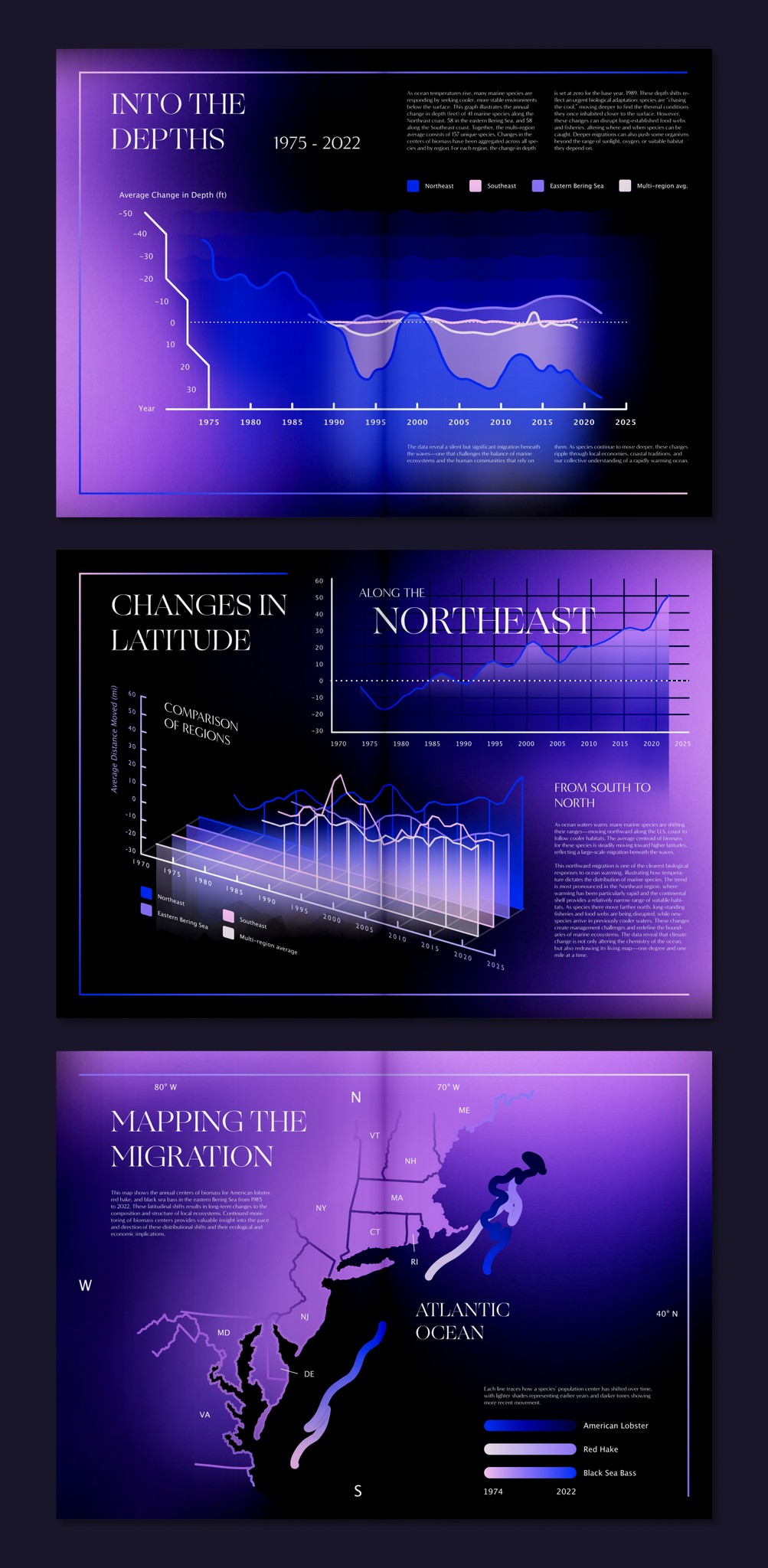
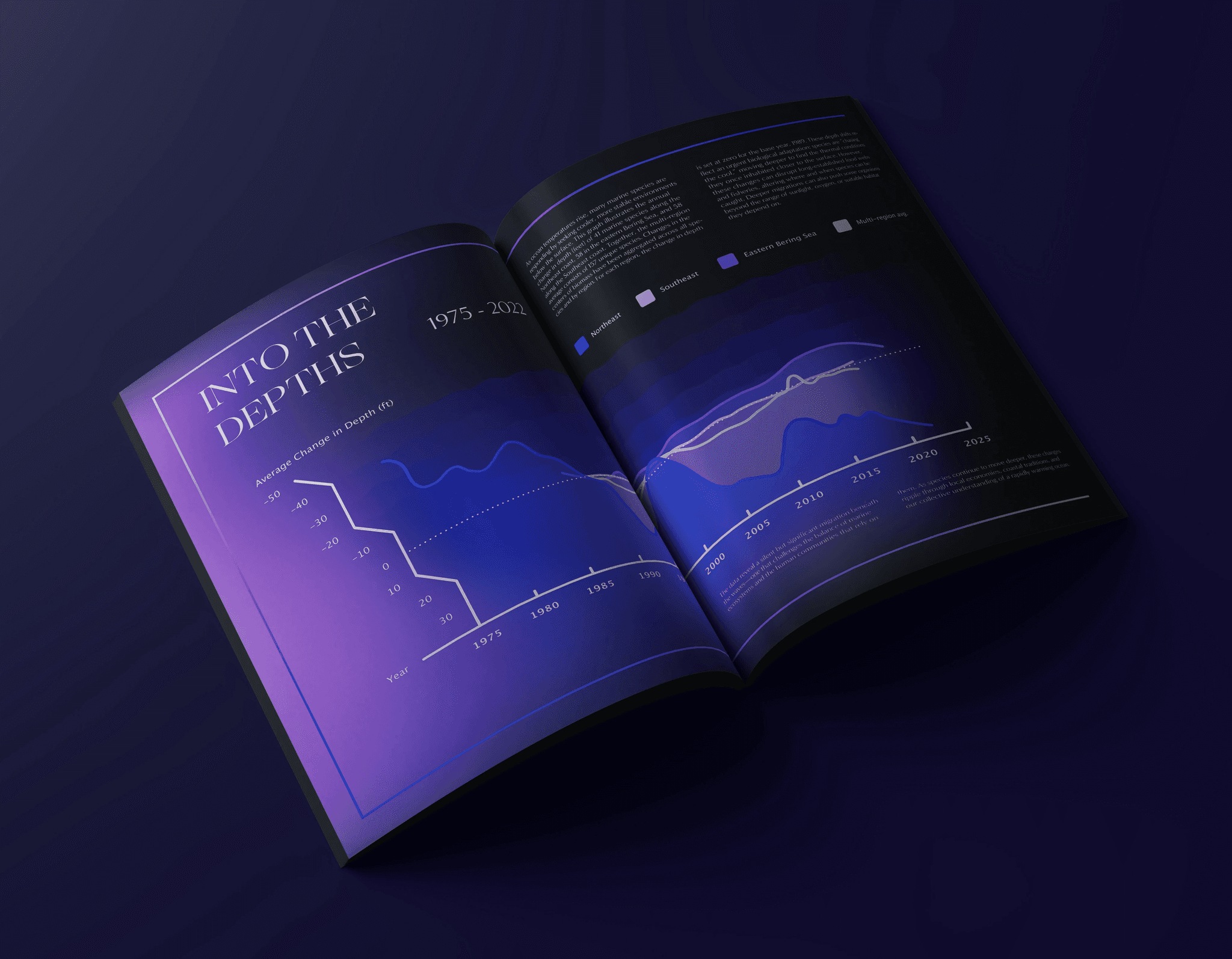
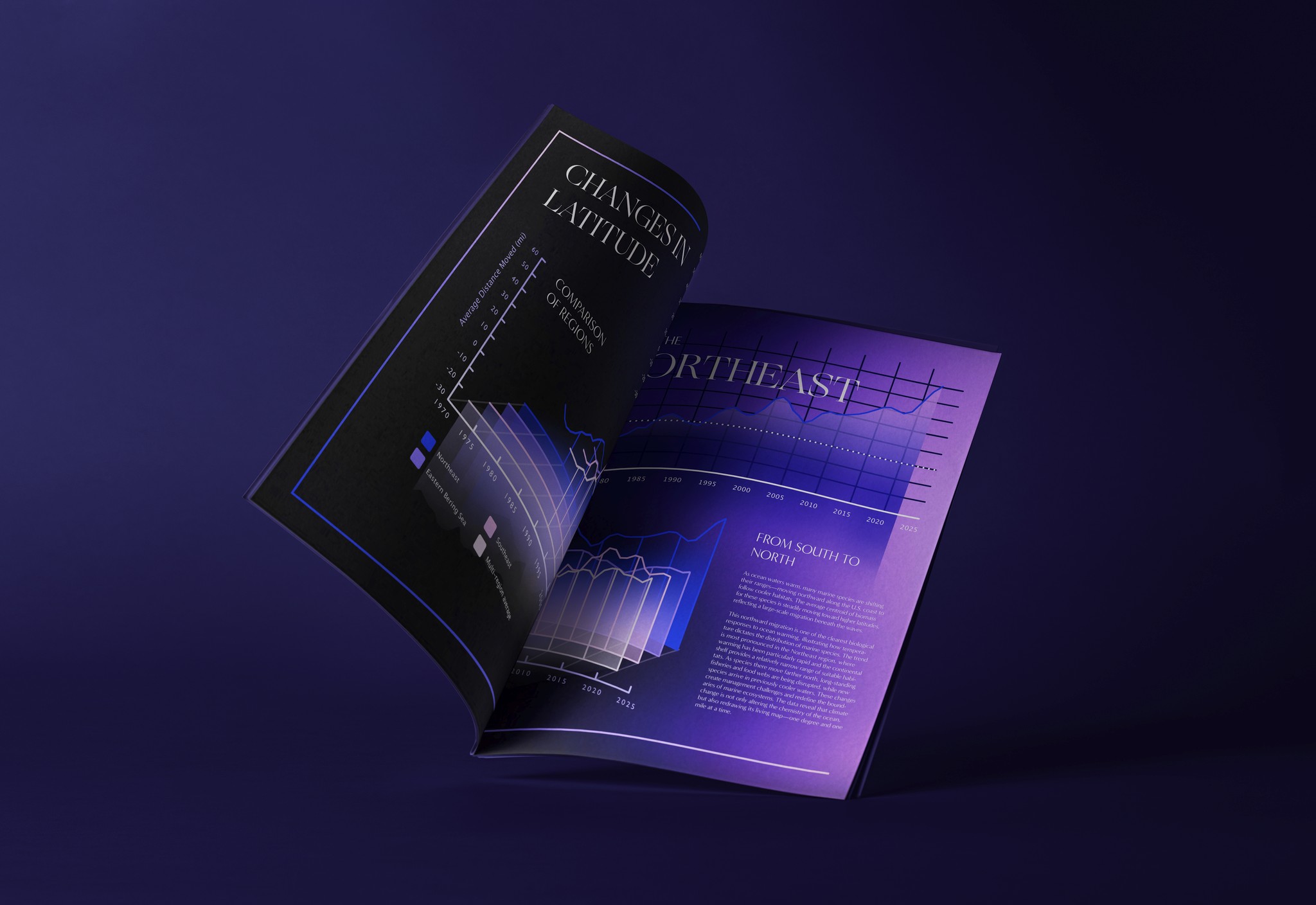
Using the Marine Species Distribution dataset from the U.S. Environmental Protection Agency, I analyzed 157 species across the U.S. coastlines, focusing on three regions: the Northeast, Southeast, and eastern Bering Sea. I visualized two primary metrics:
Change in Depth (feet) — species migrating to cooler layers below the surface
Change in Latitude (miles) — species moving northward over time
Each spread functions as a chapter in a larger story: introduction → depth change → latitude change → regional focus → call to action.

Using the Marine Species Distribution dataset from the U.S. Environmental Protection Agency, I analyzed 157 species across the U.S. coastlines, focusing on three regions: the Northeast, Southeast, and eastern Bering Sea. I visualized two primary metrics:
Change in Depth (feet) — species migrating to cooler layers below the surface
Change in Latitude (miles) — species moving northward over time
Each spread functions as a chapter in a larger story: introduction → depth change → latitude change → regional focus → call to action.

The Outcome
The Outcome
Presented as an editorial insert within National Geographic, the three-spread series combines cartographic data graphics with poetic interpretation.
Visualizing these shifts reveals how the ocean’s invisible temperature gradients are physically redrawing the geography of marine life.

Presented as an editorial insert within National Geographic, the three-spread series combines cartographic data graphics with poetic interpretation.
Visualizing these shifts reveals how the ocean’s invisible temperature gradients are physically redrawing the geography of marine life.